
Case Study von DHL Consulting: Market Entry Wine Logistics

master1305 – stock.adobe.com
In dieser Case Study, bereitgestellt von DHL Consulting, unterstützt du bei der Fragestellung, ob und wie DHL Global Forwarding in den Weinlogistikmarkt eintreten sollte.

Case Study von DHL Consulting
DHL Consulting ist eine unabhängige Management- und Supply-Chain-Beratung. Als Inhouse-Beratung übernimmt DHL Consulting Projekte für die DHL Group. Zusätzlich beraten die Mitarbeitenden externe Kunden bei strategischen Logistik-Herausforderungen. Weitere Infos zu Einstieg und Karriere bei DHL Consulting
Hinweis: DHL Consulting führt Case Interviews auf Englisch durch. Damit du dich bestmöglich vorbereiten kannst, ist auch die folgende Case Study auf Englisch.
Hintergrundinformationen
Hintergrundinformationen ausklappen
- DHL Global Forwarding is a forwarder that transports bulk shipments in containers on airplanes or ocean freighters/container ships or in trucks from point A to point B
- DHL so far has very few customers in this industry segment and is approaching the market relatively opportunistically, i.e., selectively on customer request
- The global consumption of Wine has been growing moderately and is expected to reach 25bn liters in 2013; the CAGR 2008 -3 is ~1.5%
- The outbound logistics market is primarily driven mid to small sized, partially family owned forwarders
Aufgabenstellung
As part of a strategic review, DHL (BU: Global Forwarding) is considering whether to focus on selected niche logistics markets. One of the niche markets being considered as a potential opportunity is the wine logistics market. Inhouse Consulting has been hired to define a strategy for the wine logistics market.
Problem statement: DHL expects the DHL Consulting team to provide a recommendation on whether and how DHL should enter the wine logistics market.
- Structuring: What options would you look at if you were to evaluate how DHL should enter the wine logistics market, and how would you rate each option given your market knowledge?
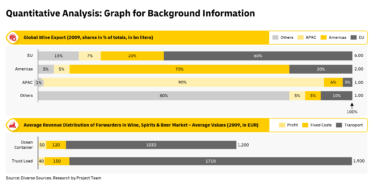
- Quantitative Analysis: Make a rough calculation on how much profit a company transporting 100 mn liters of wine in a given year makes. Use the following Graph to calculate.
- Recommendations: What logistics requirements might a wine producer/exporter have that should be translated into a service by a logistics provider?
DHL Consulting
Musterlösung
Vergleiche hier deine Überlegungen zu den Fragestellungen eins bis drei mit der Musterlösung von DHL Consulting.